ORE Catapult x Bladena – Full-Scale Torsional Fatigue Testing
Wind turbine blades have entered a new era of scale. Testing needs to keep pace.
THE PROJECT
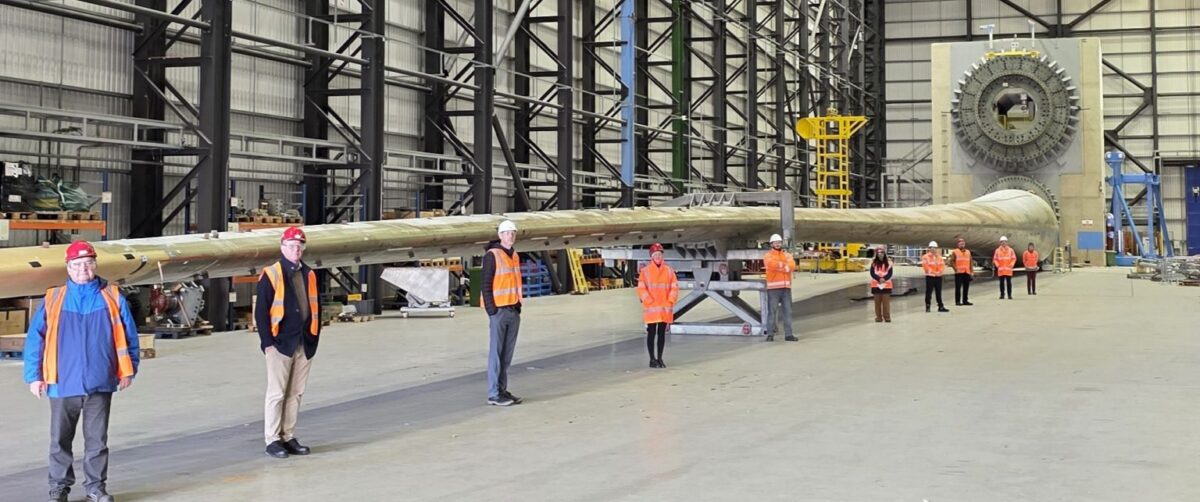
Bladena and ORE Catapult are carrying out one of the most comprehensive full-scale torsional fatigue tests ever performed on a wind turbine blade. At 88 metres, the blade being tested represents the scale modern offshore wind now demands.
The programme applies controlled torsional loading to understand how very large blades behave under real stress conditions – and to test whether structural reinforcement can reduce the deformation that leads to blade failure over time.
This page is the home for everything produced from the campaign. We will update it as the project progresses.
WHAT WE’RE TESTING
As blades grow beyond 70, 80 and now 100 metres, they experience forces that shorter blades simply did not. One of the most significant is torsion – the twisting motion a blade experiences as loads act along its span. In modern large blades, torsional loading can drive local deformation in ways that standard certification tests were not designed to capture.
This campaign tests what actually happens when an 88m blade is subjected to controlled torsional fatigue loading – and whether two structural reinforcement solutions developed by Bladena can measurably reduce that deformation.
The Lattice Bar™ is an internal reinforcement system designed to enhance torsional stiffness and control cross-sectional deformation modes observed in large blades under fatigue loading.
The D-Stiffener™ is a lightweight internal feature that strengthens the trailing edge without adding significant weight. It targets edge separation and panel breathing – failure modes especially common near the maximum chord area of long blades under cyclic torsional stress.
We are not only keeping pace with advancing blade scale – we are generating evidence that can support the industry conversation on how full-scale validation methods need to evolve.
WHITEPAPERS
We’re publishing our findings as a series of three whitepapers, covering the test setup, the measurement and instrumentation strategy, and the comparison against FEM predictions. Download each paper below as it’s published.
PROJECT UPDATES
June 2026
The 88-metre blade was lifted into position at ORE Catapult’s test facility in Blyth, marking the start of the full-scale torsional fatigue test campaign. Watch the lift in the video below.
August 2026
Paper one is published, setting out the engineering case for the test and the seven-step validation process behind the campaign. Read it in the whitepapers section above.
October 2026
The first results are in. Large wind turbine blades deform more under twisting forces than computer models predict. We applied a controlled twisting load to the 88-metre blade and tracked its response with more than 70 sensors. The model correctly predicted where the deformation would happen, but it was 10% to 50% stiffer than the real blade, so it underestimated how much. Read it in the whitepapers section above.
TECHNICAL DETAILS
Why torsional loading matters
As blades grow beyond 70 metres, torsion – the twisting motion a blade experiences as loads act along its span – becomes an increasingly important factor in long-term structural performance. In shorter, stiffer blades, torsional effects were less dominant. In modern blades over 80 metres, torsional loading can drive local deformation in ways that standard certification tests were not designed to capture.
Current industry standards acknowledge torsion as part of blade loading but were developed when blades were smaller. As blade technology has scaled rapidly, local deformation modes caused or amplified by torsional loading have become more significant – particularly in fatigue-sensitive areas such as trailing edges, shear webs and adhesive bondlines.
The test setup
The test applies controlled torsional loading to an 88m blade at ORE Catapult’s facility in Blyth. Saddle clamps are positioned around the blade’s maximum chord region to introduce torsional demand under safe and repeatable conditions. The programme comprises approximately one million fatigue cycles – not to reproduce the complete lifetime loading history of the blade, but to activate and measure specific structural responses under controlled conditions.
What we’re measuring
The blade is instrumented with over 70 sensors to capture how it responds under torsional loading. The measurement programme focuses on three key phenomena:
Cross-sectional shear deformation
The in-plane distortion of the blade cross-section
Out-of-plane panel bending
Local deformation of the blade shell panels
Breathing
The cyclic expansion and contraction of the cross-section under fatigue loading
The data directly supports validation and calibration of the structural model, improving confidence in how blade behaviour is predicted and assessed over its lifetime.
The two phases of testing
The campaign runs in two phases. The first establishes a baseline – testing the blade in its unreinforced state to understand its natural structural response before any intervention. The second installs and tests two reinforcement solutions developed by Bladena:
The Lattice Bar™
The Lattice Bar™ is an internal reinforcement system that enhances torsional stiffness and controls cross-sectional deformation. Its effect on load paths is measured directly using an integrated load cell.
The D-Stiffener™
The D-Stiffener™ is a lightweight trailing edge reinforcement targeting edge separation and panel breathing — failure modes especially common near the maximum chord area of long blades under cyclic torsional stress.
Comparing blade behaviour before and after each solution is installed provides direct evidence of whether the structural effect of reinforcement is measurable at full scale.
What the results will tell us
The campaign will generate a full-scale reference dataset for torsion-induced blade response – including global measurements of twist, rotation and displacement, and local measurements of strain and cross-sectional deformation. The data will be used to validate and calibrate structural models, improving how the industry predicts and manages blade behaviour at scale. Detailed results will be published in a series of technical whitepapers.
ABOUT THE PARTNERS
Bladena is a specialist in wind turbine blade engineering and lifecycle solutions, and part of RES – the world’s largest independent renewable energy company. Founded in Denmark in 2011, Bladena develops structural reinforcement technologies and advisory services that extend blade life and reduce operational risk.
ORE Catapult is the UK’s leading innovation centre for offshore renewable energy. Its blade test facility in Blyth is one of the most advanced in the world, providing the infrastructure and expertise to carry out testing at a scale the industry demands.
FOLLOW THE CAMPAIGN
Follow us on LinkedIn for key project updates.
FAQs
What is torsional fatigue testing?
It is a form of full-scale blade testing that applies controlled twisting forces to the blade — simulating the torsional loads large blades experience in real operating conditions. Unlike conventional certification tests which focus primarily on bending, torsional testing targets a different set of structural responses that become increasingly significant as blades grow in size.
Why does torsional loading matter for large blades?
As blades exceed 70 metres, torsional effects become a more significant contributor to structural stress and local deformation. Current testing standards were developed for smaller blades and do not fully address how very large blades behave under torsional loading. This is not a flaw in the standards – it is a natural consequence of how quickly blade technology has scaled.
What are the Lattice Bar and D-Stiffener?
Both are structural reinforcement solutions developed by Bladena. The Lattice Bar is an internal system that enhances torsional stiffness and reduces cross-sectional deformation. The D-Stiffener strengthens the trailing edge, targeting the separation and panel breathing that can develop under cyclic torsional stress. Both are being evaluated in this campaign for their measurable effect on blade structural response.
What will you do with the results?
The results will be published in a series of technical whitepapers and shared with the industry. The data will also be used to calibrate and validate structural models, improving how the industry predicts and manages blade behaviour at scale.
Who is carrying out the test?
Bladena, a specialist in wind turbine blade engineering and part of RES Group, and ORE Catapult, the UK’s leading offshore renewable energy innovation centre. The test is taking place at ORE Catapult’s blade test facility in Blyth.