
Static testing indicates large wind turbine blades deform more than computer models predict

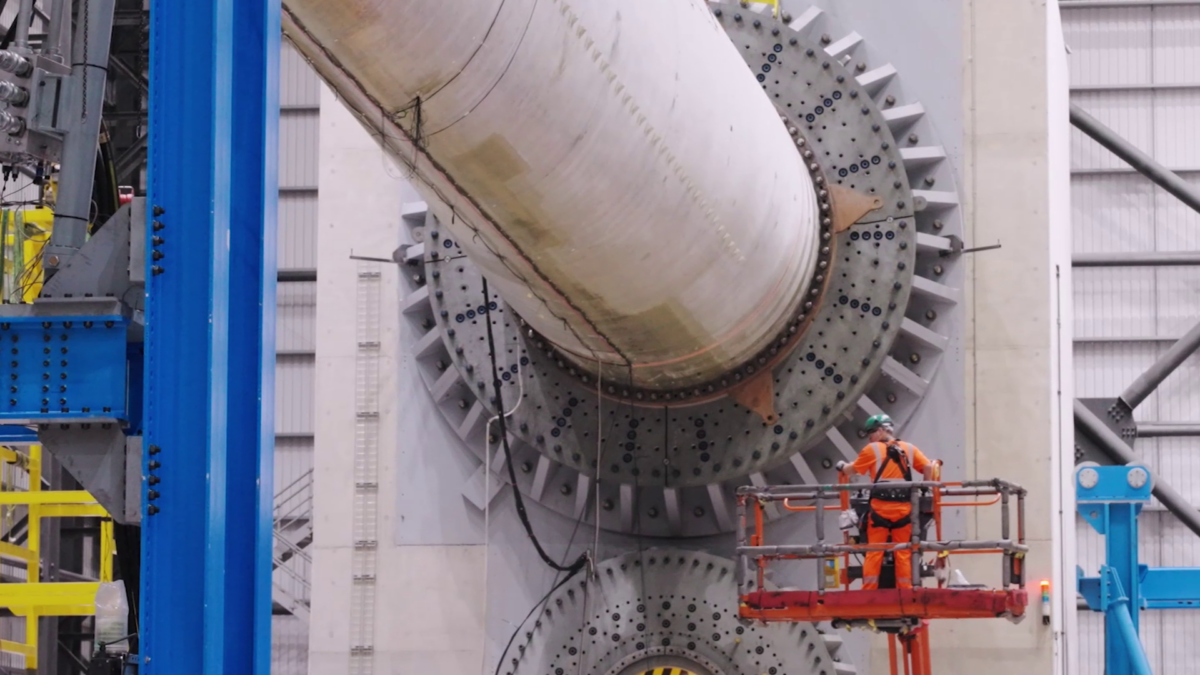
Copenhagen, Denmark – 15 October 2026 – Large wind turbine blades bend and distort more under twisting forces than computer models predict, according to the results from a full-scale static test by Bladena, a RES company, at the Offshore Renewable Energy (ORE) Catapult. The findings, published today, give the industry a clearer picture of how today’s larger blades age, helping keep turbines generating reliably and the cost of clean energy down.
Computer based models have been around for several years, but physical full-scale testing to validate them under real-world loads has been limited. Engineers applied a controlled torsional force to an 88-metre blade, almost the length of a football pitch, at ORE Catapult’s National Renewable Energy Centre in Blyth, England, and tracked its response with more than 70 sensors.
Twisting of the blade alone was enough to distort the blade’s cross-sections out of shape and bend its outer shell panels, putting stress on the internal webs and bonded joints that hold it together. Both effects are linked to known causes of blade damage.
When the team compared these measurements with a computer simulation of the same blade under the same load, the model correctly predicted where the deformation would occur but was generally 10% to 50% stiffer than the real blade. Simulations like this give insights into how long blades may last and when they need repair, so underestimating deformation means underestimating the potential damage building up inside. The measured data can now be used to validate the model, giving owners and engineers a more reliable basis for both design and maintenance decisions.
This becomes more important as blades grow. Many now exceed 80 metres, where torsional loading has a bigger effect than on earlier, shorter blades, and industry test standards were largely developed when blades were smaller and stiffer.
Find Mølholt Jensen, CTO and Founder of Bladena, said: “Every turn of a turbine blade should be delivering as much clean power as it can, for as long as it can. Blades have grown faster than the methods we use to check them, and this test shows that a model can tell you where to look but not always how big the problem is. Getting that right means fewer surprises, more reliable turbines and, ultimately, cheaper energy for homes and businesses. We are sharing these results openly because this is a challenge for the whole industry, and owners, manufacturers and certifiers will need to work on it together.”
Matthew Hadden, Chief Blade Engineer at ORE Catapult, said: “Testing at full scale is how we validate technology and modelling methods against real world conditions . Applying a controlled twisting load to a blade of this size is technically demanding, and as such needed a new bespoke testing set up within our facility. This is just the first part of our testing programme and it is already yielding data which can potentially help us understand how we can use our testing facilities to help the industry learn more about developing solutions to these challenges.
These results come from the first, static phase of the test, and are set out in the third of a series of technical whitepapers. The campaign continues with around one million cycles of repeated twisting and will go on to assess whether structural reinforcement can measurably reduce deformation. Those findings will be reported in a fourth whitepaper.
The results will be presented and discussed for the first time in person at the CORTIR III International Conference at the Thon Partner Hotel in Høje Taastrup, Copenhagen, on 29 to 30 October 2026.
The 1.5-day event brings together asset owners, operators, researchers and engineers to discuss blade reliability and how to make better maintenance decisions. CORTIR III is funded by the Energy Technology Development and Demonstration Program (EUDP), administered by the Danish Energy Agency.
Registration is open at Join us at CORTIR III International Conference 2026
Download whitepaper III here.
ENDS
Notes to editors
- The full-scale torsional test campaign is a collaboration between Bladena and ORE Catapult, announced in November 2025.
- The 88-metre blade is instrumented with more than 70 sensors. Local deformation was measured using string potentiometers and BODEM, an advanced system for measuring local blade deformation.
- The Wood Mackenzie Global onshore wind O&M correctives and spares 2025 report predicts blade repairs and replacements will represent 30% of unplanned O&M spend by 2034.
- Whitepaper III reports results from a one-direction static torsional load. The two local deformations measured were cross-sectional shear distortion (CSSD) and out-of-plane panel deformation, in the maximum chord region and transition zone. Results were compared with an independent finite element (FEM) model under the same load case.
- Whitepaper III is the third in a series. Whitepaper I set out the test concept and setup, and Whitepaper II the load introduction and measurement strategy. All papers are available at https://bladena.com/ore-catapult-x-bladena-full-scale-torsional-fatigue-testing/
- Images and video of the blade test are available on request.
About Bladena
Bladena is a specialist in wind turbine blade engineering and lifecycle solutions, and part of RES, the world’s largest independent renewable energy company. Founded in Denmark in 2011, Bladena develops structural reinforcement technologies and advisory services that extend blade life and reduce operational risk.
About ORE Catapult
The Offshore Renewable Energy (ORE) Catapult is the UK’s leading technology innovation and research centre for offshore renewable energy. Established in 2013 by the UK Government as part of the Catapult network set up by Innovate UK, it brings together industry and academia to drive innovation and accelerate the growth of UK companies in offshore wind, wave and tidal energy. Its facilities include the National Renewable Energy Centre in Blyth, Northumberland, home to one of the world’s most advanced blade test facilities. Visit: ore.catapult.org.uk
Contact for more information
Rory Brown
RES press office
[email protected]
+44 7436 144 750