
How do we make wind farm blade failures a problem of the past?

By Mathias Reding, Director of Engineering, Bladena
Blade reliability remains a critical focus, with recent failures not only increasing the levelised cost of energy but also risk reputational damage and create safety concerns, affecting relationships with communities and investors.
Across RES, we have catalogued over 1 million instances of damage across 100,000 blades to date, giving us deep insight into long-term performance and failure patterns, particularly for blades with five or more years in operation where statistical trends become more robust. We also have early-stage insights from design reviews, testing data and failure cases across more than 130 blade models, including the latest multi-megawatt platforms, adding further depth to our understanding.
Blade failures are rarely caused by a single factor; more often, they reflect a complex interplay of design, manufacturing, transport and operational stresses . While manufacturing and quality assurance are actively improving, aligning design more closely with operational data could be the key to further reducing failures – helping the industry scale power output in a cost efficient way that minimises risk.
Blade length and stress do not scale evenly
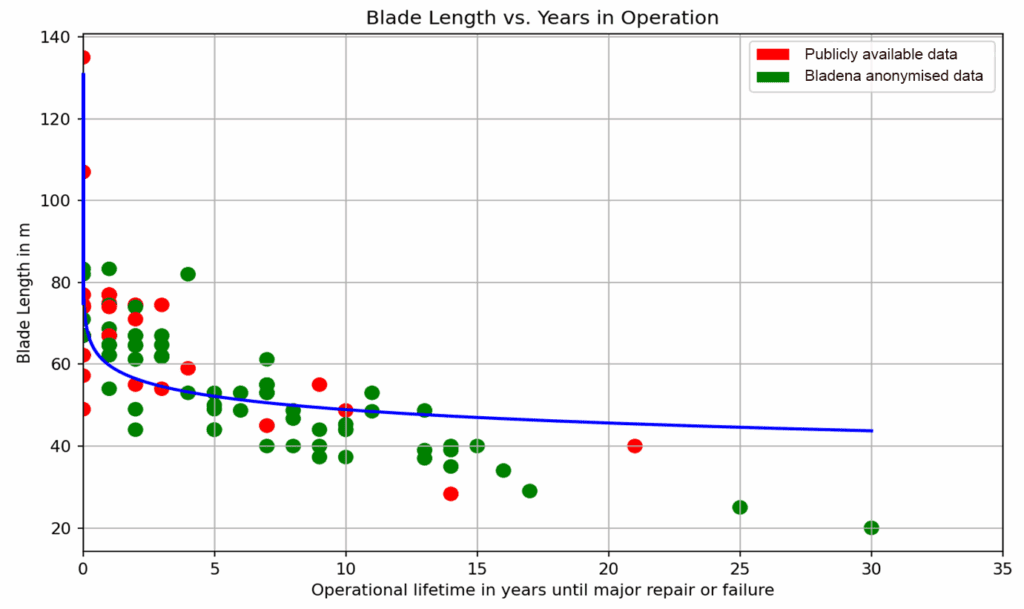
Recent analysis completed by Bladena shows a potential correlation between the likelihood of blade failure within the first five years of operation and blade length. Leading to the conclusion that a key contributing factor in more frequent blade failure could be down to how blade designs are being scaled for larger turbines. Longer blades – which are common today – incur more stress proportional to shorter blades. As most longer blade designs are simply scaled up versions of shorter blades, this additional stress has not been properly factored into the design.
Standards and testing do not fully reflect real-life conditions
Design flaws like these should, in theory, be caught during testing. But there’s a disconnect between what blades are tested for and the conditions that they face in real-life operations, and the gap is widening as larger turbines come to the market.
Designers work to meet the test criteria required for certification, but for longer blades, the criteria is not being revised often enough to reflect the higher stress and fatigue that those blades will experience in operation. As a result, we continue to see issues, which implies that blade design continues to outpace certification criteria. One example we noted from our own analysis is the limited requirements for assessing torsional load.
The current design basis only considers the loads associated with displacements in the edgewise and flapwise direction independently and not the combined three-dimensional effect which is found under actual turbine operating conditions. As a result, a blade can pass certification but still fail within months in the field.
In the race to launch more powerful turbines to accelerate the energy transition, engineers are often designing the next model before field data from the previous version is available to inform design improvements. Without resetting the design methodology, old assumptions persist, even though the data shows new blades behave differently.
Pioneering new testing for real-world conditions
To better understand how blades respond under real operational stresses, Bladena, in collaboration with the Offshore Renewable Energy (ORE) Catapult, is launching full-scale testing of next-generation blade reinforcement technology. Using an 88-metre blade at ORE Catapult’s National Renewable Energy Centre, this programme will carry out torsional load tests for the first time at this scale. The results will help refine blade designs, improve operational longevity, and guide future industry standards, bringing testing closer to the real-world conditions blades experience at sea.
Solving the issue with detailed root cause analysis data
As innovation accelerates to meet net zero ambitions, it is paramount that we align design and testing to real-life scenarios and close the feedback loop for good. Conveniently, the data already exists to do this. By analysing failure data across 130+ blade models, from early designs to today’s multi-megawatt platforms, we’re uncovering the patterns and risks that allow for better decisions across the full blade lifecycle.
The potential impact is vast – billions of dollars in remanufacturing, AEP losses and reputational damage could be abated through a more rigorous approach to applying data insights.
What’s failing most?
Based on our analysis, the five most critical failure modes we see include:
- Trailing edge cracking and bondline failure
- Transverse cracks in the max chord area
- Shear web bondline failure
- Cracks & irregularities in transition zones
- LPS (Lightning Protection System) related damages
We’ll explore each of these in more detail in a dedicated blog series, sharing what to look for and how to respond before it leads to failure.
If you’re already facing persistent blade issues, now is the time to act.
A robust root cause analysis, grounded in real-world failure data, can uncover hidden drivers and support targeted interventions that reduce risk before it escalates.
We have the data to fix this, so together, let’s make blade failure a thing of the past.