Why blades fail: A trailing edge split starts long before you can see it

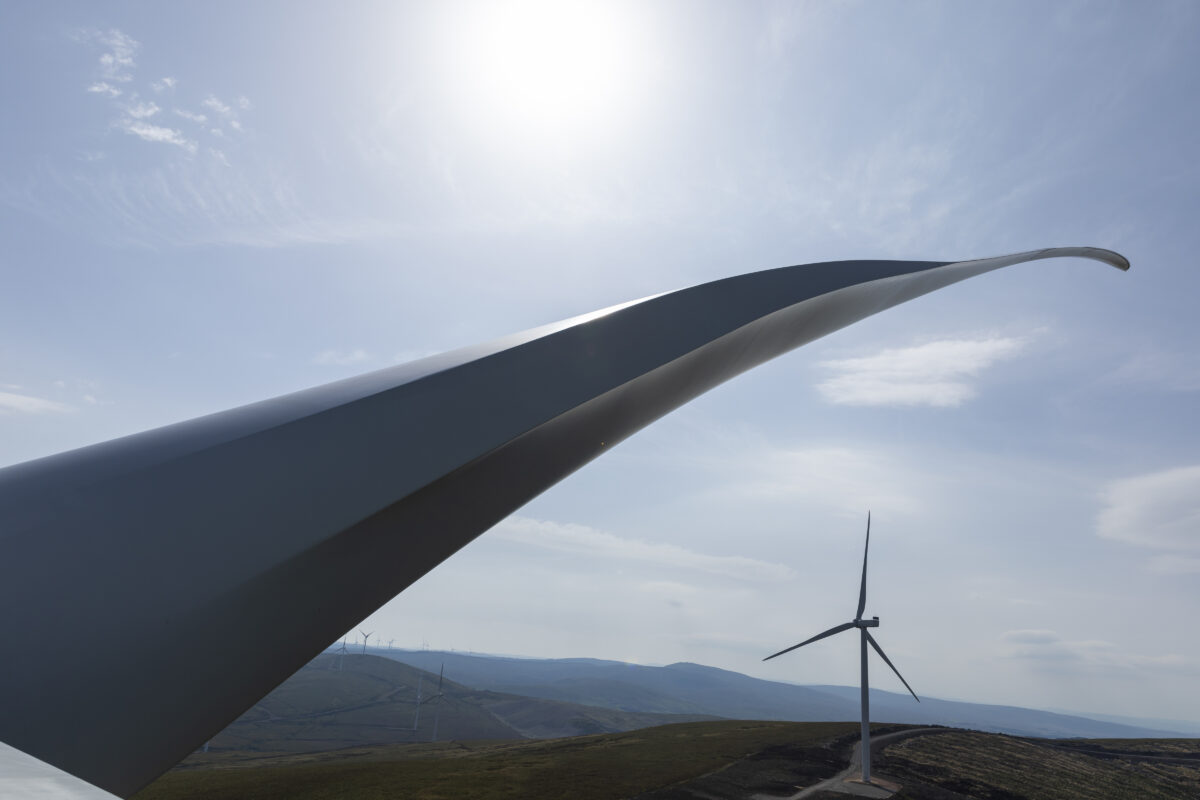
A crack along the trailing edge rarely looks like much: a thin line on the back of the blade, quick to note in an inspection report and easy to leave for the next visit. That instinct to log it and move on is one of the costliest habits in blade maintenance.
Here is the uncomfortable part: by the time that thin line is visible at all, the story is already well underway. A failing trailing edge bondline starts from the inside. While peeling forces work away at the adhesive, there is nothing for a drone, a rope team or even an internal inspection to find. When the damage finally shows itself as a hairline crack on the trailing edge, it has already reached a critical state, and that is the moment to act, either by repairing the bondline or by proactively removing the root cause that created the failure in the first place.
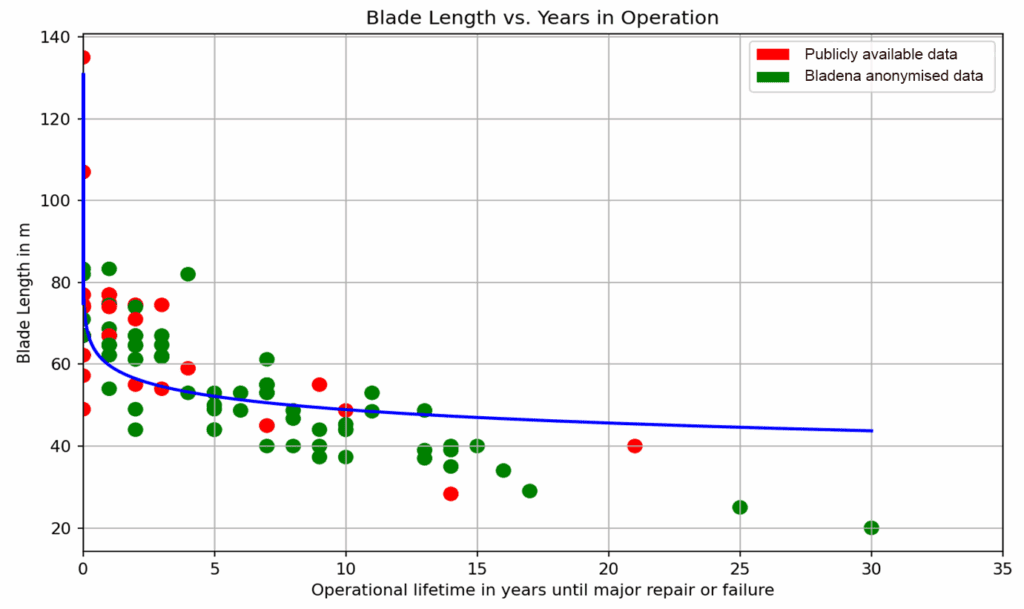
It is worth acting on, because it is one of the most common failure modes we see in Bladena’s damage data, and it is not reserved for the newest giants: blades well under 60 metres show exactly the same damage.
In short: trailing edge bondline failure is caused by the blade panels repeatedly moving away from and towards each other under load, a behaviour known as breathing, which transfers peeling forces directly into the adhesive holding the trailing edge together until it cracks and, in time, opens.
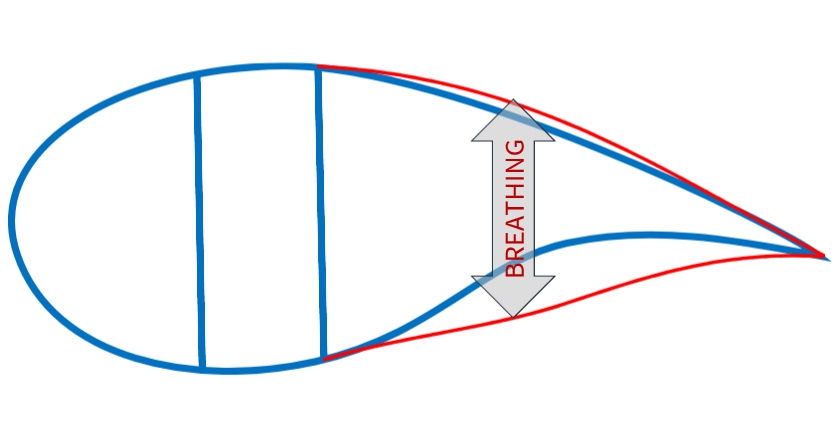
What the trailing edge actually does
A blade is two moulded shells (a pressure side and a suction side) bonded together. They meet along the trailing edge, the thin rear edge that runs almost the full length of the blade. That joint does real structural work: it holds the two shells of the blade together, acting as a single stiff structure under load.
Why the bondline starts to fail
As the blade rotates, gravity pulls on it in alternating directions depending on which side of the blade is facing the ground, introducing a sideways, edgewise motion again and again. In the widest part of the blade, the max chord region, that sideways fatigue drives the two shell panels away from and towards one another in a breathing motion. Breathing is the principal driver behind most trailing edge bondline failures.
Every breathing cycle transfers peeling stress into the adhesive, and those cycles accumulate relentlessly over a blade’s operational life. Over time the bond degrades, a crack forms between the adhesive and the blade panel, and once that crack has worked its way to the trailing edge, the edge can split open. At that point the blade needs to come out of service until it is repaired. How long that final stage takes varies from blade to blade, and it is neither easy to predict nor possible to control.
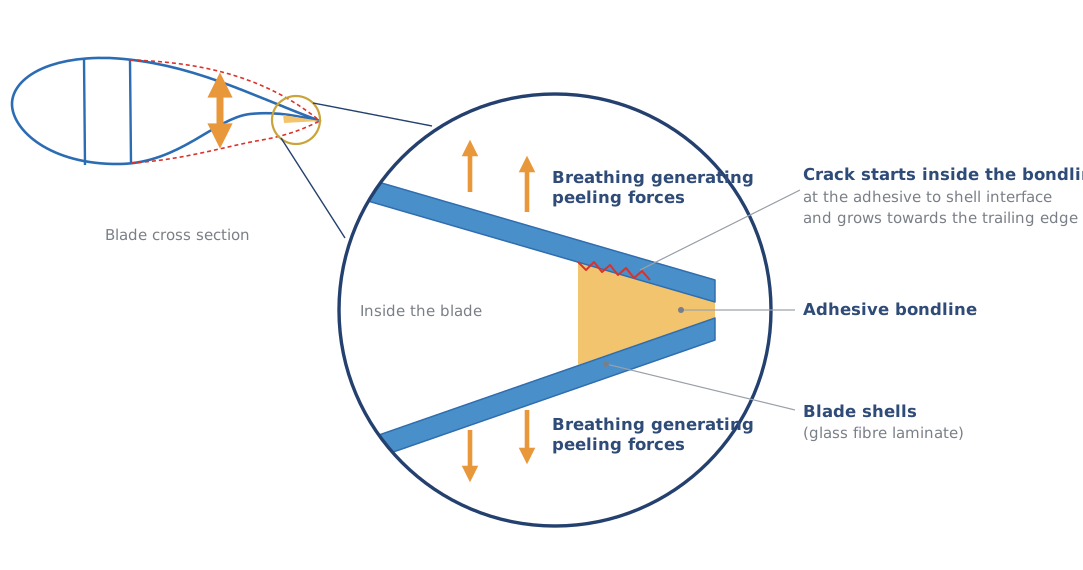
The mechanism is remarkably consistent, which is why the same failure surfaces across so many different blade types. What changes is the speed: the real loads a blade carries, its design and variation in how the bond is made all combine to determine whether, and how quickly, a given blade reaches an open trailing edge.
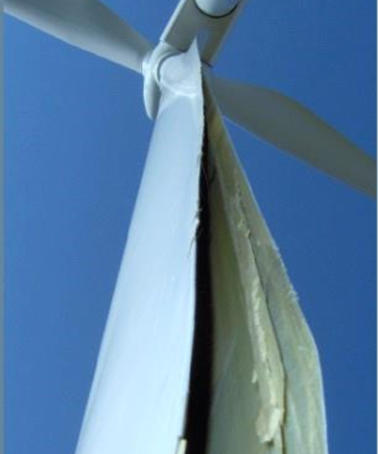
Bigger blades, higher stakes
Blades keep getting longer, and the loads on them are growing faster still. As Mathias Reding, Managing Director at Bladena (RES), puts it: “While the frequency of blade damage may have only slightly increased, the severity of damage has risen sharply with blade length. This leads to higher costs related to downtime, repair and replacement.” (How do we make wind farm blade failures a problem of the past?) The failure mode has not changed. The stakes have.
What inspection sees and when
This is where the hidden start of the failure matters most. While peeling damage progresses inside the bondline, there is nothing on the surface for a drone or a rope team to find. The damage only becomes detectable at a late stage, when the first hairline crack appears and the bondline is already in a critical state. So when an inspection confirms a crack and roughly how long it is, it is telling you the story late and it still cannot tell you why. Two blades can present near-identical cracks in a photograph and be on completely different trajectories: one stable for years, one months from splitting open.
Timing adds a second challenge. Because the damage develops out of sight and only becomes visible late, a routine inspection interval can miss the window entirely: the crack appears after one visit and the trailing edge has split before the next. Where repeat damage is suspected, targeted inspections are strongly recommended, focused on the max chord trailing edge and timed to the risk.
Severity, in other words, is a structural question, not a visual one. Without knowing the driver behind a crack, an operator ends up repairing the symptom while the cause keeps working. That is how sites end up paying to fix the same trailing edge twice or more.
Regular inspection is still essential: it is how cracks are found at all. But on its own it tells you where the damage is, not why it is there or how fast it will grow.
What trailing edge repair actually costs
Caught early, this is a manageable job: a bonded, up-tower repair carried out while the blade keeps producing, at modest cost. Left to run, the economics change fast. The crack propagates, the trailing edge opens, and the options narrow to a major section repair or a full blade replacement: a crane, a blade out of service, and lost production for the duration. Offshore, add vessels and weather windows to the bill.
The figure an asset manager should notice is not the cost of one early repair; it is the multiple of that cost paid when a small crack is logged, left for the next visit, and grows into a section repair.
D-String®: removing the root cause of the failure
Bondline failures in the trailing edge have a structural root cause, and that means it can be addressed structurally. Bladena’s D-String® retrofit was developed to do exactly that: it removes, or strongly reduces, the breathing motion between the trailing edge panels, taking away the peeling stresses that drive the bondline to failure. Installed proactively, it stops the damage from forming; installed after a crack has appeared, it stops the cause from continuing to work while the repair holds.
Because a targeted intervention only has to be paid for once, it avoids the cost of repairing the same trailing edge again and again. As a welcome side effect, it also mitigates transverse cracks in the large max chord panels. But that is a story for a later blog in this series.
Talk to us before it becomes a fleet problem
If you are seeing repeat trailing edge cracks across a site, or the same crack on the same blade type turning up more than once, that is a signal, not a coincidence. A root cause analysis will tell you whether you are dealing with a local repair or a fleet-wide exposure and what it will take to stop it recurring.
This blog is part of the Why Blades Fail series, a companion to Seeing the full lifecycle (on the RES blog) and How do we make wind farm blade failures a problem of the past?
Author:
Margrethe Werk, Senior Structural FEM Engineer
Margrethe Werk has worked in the structural department at Bladena, a RES company, for more than 11 years.
Her work focuses on how wind turbine blades respond structurally under different loading scenarios, and how blade characteristics, such as internal and external geometry and laminate layup, influence that response. She is also involved in developing Bladena’s structural solutions, such as D-String®, including how they remove the root causes of structural failures and when they should be installed.
Margrethe holds a Bachelor’s degree in Mechanical Engineering from the Technical University of Denmark (DTU) and is the author of Bladena’s “Why Blades Fail” blog series.

FAQs
What is trailing edge bondline failure in wind turbine blades?
Damage to the adhesive bondline that joins the two shells of a blade along its trailing edge. It begins as peeling inside the bondline, invisible from outside, develops into hairline cracks and, over time, lets the trailing edge split open. It is one of the most frequent structural failures in the field, including on blades under 60 metres.
What is the max chord region?
The widest part of the blade, where the distance from leading edge to trailing edge is greatest, sitting between the root transition and mid-span. Because the shell panels here are large, curved and relatively unsupported (in many designs the distance between the trailing edge and the nearest shear web is large), it is the region most prone to the breathing motion that drives trailing edge bondline failure.
What is breathing between the blade panels?
The in-and-out movement of the blade’s two shell panels relative to each other as the blade flexes in edgewise fatigue under operation. It is most pronounced in the max chord region, and each cycle puts peeling stress on the adhesive bondline, which is why breathing is the main driver behind trailing edge bondline failure.
How serious is trailing edge bondline failure?
More serious than it looks. The bondline holds the two shells of the blade together, so once the trailing edge starts to open, the blade loses stiffness. Left unaddressed, a minor crack can escalate into a section repair or a full blade replacement.
Can trailing edge bondline failure be repaired?
Yes – and early repair is far cheaper. Caught early, it can often be fixed up-tower while the blade stays in service. The key is treating the cause, not just resealing the crack, or the same failure returns.
Can trailing edge bondline failure be prevented?
Yes. The D-String® retrofit solution is designed to mitigate the root cause, breathing, before it damages the bondline. Installed proactively, it prevents the damage from forming, or from progressing further if the damage has already started.
Is this failure mode due to poor blade design and/or a phenomenon seen only for a few manufacturers?
Wind turbine blades take a huge amount of skill and expertise to design then manufacture consistently to match complex drawings, work instructions and standards, within moulds that can now be longer than the wingspan of the biggest aircraft. Aerodynamic efficiency, structural strength, resilience and cost are just some of the design factors, often at odds with each other, that manufacturers must consider. So, there is no surprise that some blades will need some additional support throughout their lifetime, particularly when you consider the varying environmental conditions they are exposed to once in operation. And, the OEM can be a great source of information and expertise when it comes to operational repairs.