For underwriters, claims managers and loss adjusters working in wind.
This webinar has now taken place. Request the recording using the form below.
About the session
Most blade losses do not start with catastrophic failure. They come from accepted risks that compound quietly across portfolios until they show up on the balance sheet.
This focused expert panel examined what is already driving loss ratios without triggering alarms, and asked the harder question: when a blade is repaired, has the risk actually been removed or just postponed?
Event date: Tuesday, 23 June 2026 Time: 11.00 am BST (12.00 pm CET) Format: Online – Microsoft Teams
What was covered
End of warranty: the hidden risk. How responsibility shifts overnight when OEM cover ends, why damage accumulates unseen between inspections and how inconsistent data hides root causes from underwriting.
How a blade claim actually plays out. The claims process from notification to settlement. Why cause is rarely obvious and how independent root cause analysis shortens disputes and protects reserves.
Lightning: not always force majeure. Why lightning protection systems are not bulletproof, how damage can surface months after a strike and why full strike history drives accurate liability calls.
Meet the speakers:
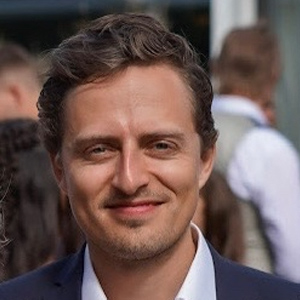
Mathias Kristian Reding, Bladena, Director of Engineering
Mathias leads global engineering strategy at Bladena. With over 15
years of engineering experience – nine of them specialising in wind
turbines – his expertise spans root cause analysis, structural blade
solutions and lifecycle management. He brings hands-on experience
diagnosing blade failures and supporting data-driven decisions on
repair, replacement and long-term asset strategy.
George Pooley, Managing Partner, Green Partners Adjusting
George brings over two decades of international experience in
renewable energy loss adjusting. He co-founded Green Partners
Adjusting and is known for leading effective teams on complex
renewable energy claims. Before Green Partners, he led the renewable
energy loss adjusting division at GRS Claims Solutions and previously
founded and served as CEO of Renewable Energy Loss Adjustors (RELA).
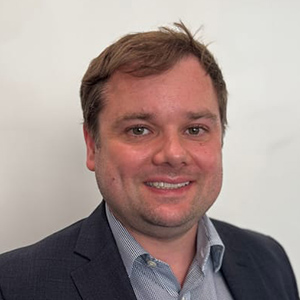
Nicholas Baker, Founding Partner, Green Partners Adjusting
Nicholas co-founded Green Partners Adjusting, a specialist loss
adjusting firm serving insurers on large-scale renewable energy
projects globally. With over a decade of exclusive focus on renewable
energy, he specialises in high-value, complex claims across wind and
solar assets. A CII qualified professional with a BEng and MSc,
Nicholas started his career as an oil and gas engineer – a technical
background that directly shapes his approach to claims analysis and
portfolio exposure.
The closing event for the CORTIR III project — bringing together project results, industry insights and a shared roadmap for what comes next in blade reliability and decision-making.
The CORTIR III project, led by Bladena and funded by the Energy Technology Development and Demonstration Program (EUDP) – which is administered by the Danish Energy Agency, is pioneering a risk-based maintenance approach to help reduce the LCOE (Levelized Cost of Electricity) across the wind sector.
CORTIR III is a 1.5-day international conference closing event presenting results from the project. The first half-day is dedicated to presentation of the CORTIR III deliverables and technical results, while the second day focuses on wider industry discussion through panels and invited contributions from relevant partners and stakeholders across the wind industry. The conference is designed to link project findings with the broader challenges of blade reliability, structural risk, and decision-making in practice.
Most value in wind assets is not lost at failure. It is lost much earlier, in decisions made under uncertainty. This conference is about how to make those decisions with confidence, when blade data is incomplete, signals are mixed, and the cost of being wrong is high.
You will leave with a clear, practical way to make blade decisions without over-reacting, over-spending, or waiting for data that never fully arrives.
This is not about producing more analysis. It is about making better decisions earlier. Practical solutions to reduce the structural risk associated with known blade failure modes will also be discussed in the context of when they meaningfully change the risk picture, when they do not, and how they should be evaluated as part of a broader risk-based decision framework.
Risk-based decision framework
A structured approach to deciding when to act, when to wait – grounded in real blades reliability results.
Clarity on where money actually matters
Understand how to treat maintenance budget as a risk strategy, avoiding both over-maintenance today and surprise failures tomorrow.
Confidence before failure
Understand how to protect revenue before damage becomes critical, by focusing on risk trajectory rather than today’s snapshot.
Signal over noise
Learn to separate structural risk from inspection noise, so attention and capital go where they create real value.
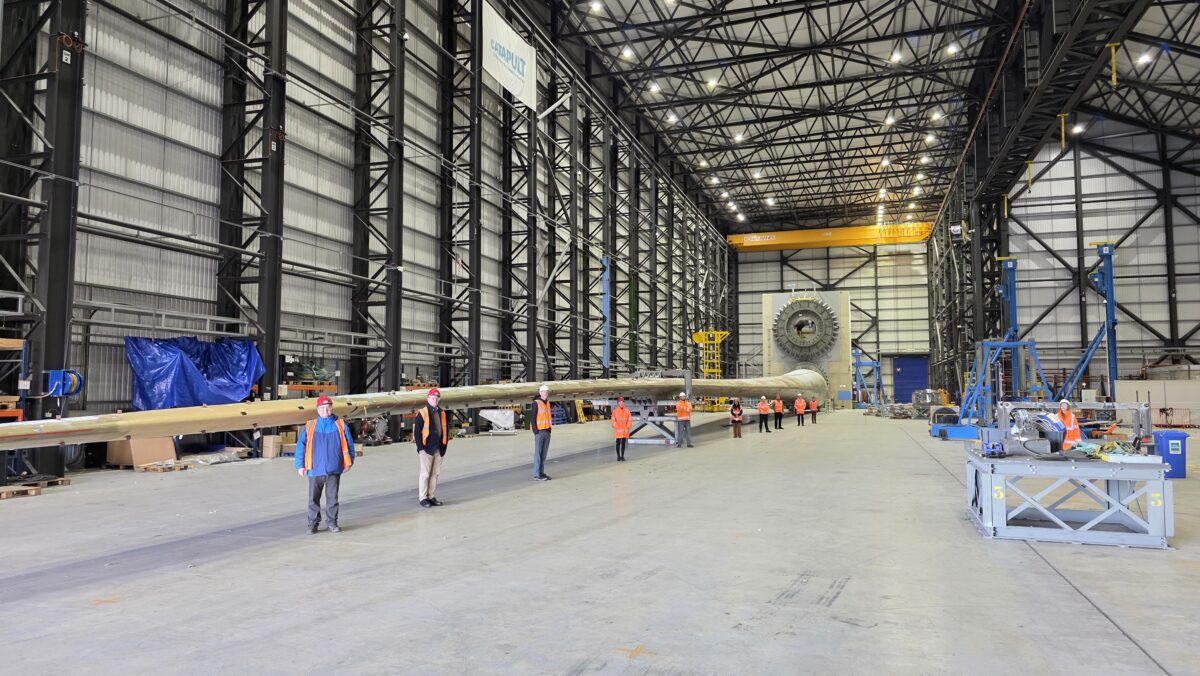
The conference will provide an update on the full-scale testing programme, conducted in partnership with ORE Catapult. The test, undertaken on an 88-metre blade to conduct torsional load and understood to be an industry first, simulates the twisting forces a blade can experience in operation. This test replicates realistic loading on a large blade and provides rare validation of what actually works as a risk mitigation measure, not just what looks good on paper.
On 2 July, we’ll be attending Energy Insurance London 2026, where insurers, brokers and renewable energy specialists come together to explore the challenges shaping today’s risk and claims landscape.
As the sector evolves, topics such as changing risk profiles, claims strategies and the growing role of renewable technologies are becoming increasingly complex. This event provides an opportunity to exchange perspectives and gain practical insight into how the industry is adapting.
If you’re attending, visit our team to discuss how independent root cause analysis (RCA) can support more confident underwriting, clearer liability decisions and stronger claims outcomes.
Event date: 2nd July 2026 Location: The Mermaid, London Blackfriars Event website: https://energyinsurancelondon.com/
Panel discussion: Claims – Repair, Replace or Abandon?
This session explores how rapid technological change is reshaping claims strategies in the renewable energy sector. It will examine how decisions to repair, replace or abandon assets are made, the impact of business interruption, and how engineering insight and new technologies are supporting faster, more effective claims resolution.
Bladena’s independent root cause analysis provides a critical foundation for these decisions—helping insurers clearly understand blade failures and supporting confident, evidence-based outcomes.
Bringing both engineering depth and an operator perspective, Mathias will share how RCA and technical insight can strengthen claims decision-making in complex scenarios.
Why attend our panel discussion:
Gain insights from a real operator perspective
Understand how engineering expertise and root cause analysis (RCA) shape claims decisions
Learn how performance and asset condition influence risk, downtime, and claims outcomes
Explore practical approaches from Bladena (a RES company)
Connect with experts across insurance and renewable energy
Meet the expert
Mathias Kristian Reding. Director of Engineering Mathias leads global engineering strategy for wind turbine blade solutions at Bladena, combining structural expertise with real-world operational insight. He works closely with insurers and asset owners to deliver independent root cause analysis and technical guidance across complex claims and performance challenges.
With over 15 years of engineering experience—including nine years specialising in wind turbines—his expertise spans RCA, structural blade solutions, asset management, R&D, and both laboratory and field testing.
Mathias has extensive experience in diagnosing blade failures and supporting data-driven decisions on repair, replacement and long-term asset strategy, providing insurers with the clarity needed to make confident, defensible decisions.
If you’re attending and would like to discuss a live claim, underwriting challenge or blade failure scenario, arrange a meeting with our team during the event.
By Andrei Buliga, Digital Blades Project Director at RES, supporting Bladena
When a wind turbine blade fails, insurers need more than a description of the visible damage. They need to understand what happened, why it happened, who may be responsible, and whether the same issue could affect other assets.
That clarity is not always easy to reach. Early information can be limited, conflicting or shaped by the interests of different parties. And where uncertainty remains, insurers can face greater exposure to dispute, misattribution, repeat failures and long-term cost.
Bladena provides independent root cause analysis for wind turbine blade failures, helping insurers make evidence-based claims decisions with greater confidence.
When the cause is unclear, claims decisions become harder
Blade failure claims can quickly become complex. Multiple stakeholders may be involved, each with their own interpretation of the incident. When there is no clear, independent technical evidence to rely on, it can be difficult to separate fact from assumption, or to determine whether a proposed repair addresses the real cause of failure.
For insurers, this creates uncertainty around some of the most important questions in the claim:
• What was the actual failure mechanism? • What factors contributed to the failure? • Is the failure isolated, or could similar assets be exposed? • Are proposed repairs technically appropriate? • Is there enough evidence to support a clear liability position? • Could the same issue happen again
Visible damage does not always explain the true failure
Conventional approaches often focus on where a blade has failed, what repair may be required and what can be seen on the surface. But visible damage is often the outcome of a deeper issue, not the explanation in itself.
Wind turbine blade failures are rarely driven by a single factor. Their behaviour can be shaped by design characteristics, manufacturing conditions, transport stresses and operational loading. In many cases, the true cause of failure only becomes clear when these factors are assessed together. That’s why root cause analysis is so important.
Bladena’s RCA process is designed to reconstruct the sequence of events leading to failure. By combining specialist blade structural assessment, operational evidence, modelling and simulation, Bladena helps distinguish between the visible symptoms of damage and the true origin of failure.
[Comparison table]
Conventional approaches may focus on…
Independent RCA helps reveal…
What damage is visible
Why the failure occurred
What repair may be required
Whether the repair addresses the underlying cause
The individual incident
Whether there may be wider fleet-level exposure
Differing stakeholder interpretations
Evidence-based understanding of causation
The visible blade condition
A defensible basis for claim evaluation
Evidence-led insight for clearer claims decisions
Bladena’s independent root cause analysis gives insurers a more robust technical basis for claim evaluation, liability discussions and future risk assessment.
With RCA and specialist structural analysis, insurers can:
• Establish a clear, unbiased understanding of what happened • Assess liability using objective technical evidence • Distinguish between failure symptoms and failure origins • Validate whether proposed repairs address the true underlying cause • Evaluate the risk of recurrence across similar assets • Support negotiations with transparent, defensible documentation • Make more informed decisions across claims, underwriting and risk evaluation
This can be particularly valuable in multi-party claims, where differing perspectives and commercial interests can make resolution more difficult.
Independent RCA in action: disputed blade failure claim
Bladena combines specialist structural insight with practical understanding of turbine behaviour in the field. As part of RES Group, Bladena’s insight is strengthened by real-world operational experience across a global renewable energy portfolio.
If you’re working through a disputed claim, liability question or blade failure scenario, Bladena can provide independent technical insight to support claim evaluation, liability discussions and repair decisions.
Following a blade break incident, an insurer faced a disputed claim involving multiple stakeholders and differing interpretations of the technical cause.
The insurer needed an independent assessment to clarify the failure mechanism, understand whether the event was isolated or indicative of wider fleet risk, and establish a defensible position for claim resolution.
The challenge
Different parties had presented different views of causation, leaving the insurer without the clarity needed to assess liability or move the claim forward. Bladena was brought in to provide an independent investigation that could go beyond surface-level damage interpretation and determine the underlying failure mechanism.
Bladena’s role
Bladena carried out an independent root cause analysis, delivered without commercial ties to any of the parties involved. The investigation combined specialist blade structural assessment with operational evidence to determine the true cause of failure.
This approach allowed Bladena to test different explanations, rule out unsupported assumptions and build a clear technical causation narrative.
The impact
The RCA gave the insurer a clear, unbiased and technically substantiated basis for claim evaluation, liability discussions and stakeholder alignment.
The findings supported: • a clearer causation narrative • improved liability clarity • reduced uncertainty in claims decisions • faster claim resolution • reduced dispute complexity • a stronger negotiation position • better visibility of potential fleet-level risk
For the insurer, the value was not only in understanding a single failure. It was in gaining the evidence needed to make a confident decision under scrutiny.
Andrei is Digital Blades Project Director at RES, specializing in structural blade performance. Trained in advanced wind‑energy engineering with deep grounding in blade physics and years of RCA work, he brings a proven understanding of how blades behave and fail under real operating conditions. Andrei’s expertise and insight allow him to convert structural blade knowledge into risk‑anchored decisions.
He brings a forward‑leaning, engineering‑driven vision to the industry as an author and conference speaker. His guiding principle: physics first — everything else is noise.
Bladena is part of RES, following its recent acquisition, and focuses on advanced blade analytics and performance solutions. Read our recent press release.
By Mathias Reding, Director of Engineering, Bladena
Blade reliability remains a critical focus, with recent failures not only increasing the levelised cost of energy but also risk reputational damage and create safety concerns, affecting relationships with communities and investors.
Across RES, we have catalogued over 1 million instances of damage across 100,000 blades to date, giving us deep insight into long-term performance and failure patterns, particularly for blades with five or more years in operation where statistical trends become more robust. We also have early-stage insights from design reviews, testing data and failure cases across more than 130 blade models, including the latest multi-megawatt platforms, adding further depth to our understanding.
Blade failures are rarely caused by a single factor; more often, they reflect a complex interplay of design, manufacturing, transport and operational stresses . While manufacturing and quality assurance are actively improving, aligning design more closely with operational data could be the key to further reducing failures – helping the industry scale power output in a cost efficient way that minimises risk.
Blade length and stress do not scale evenly
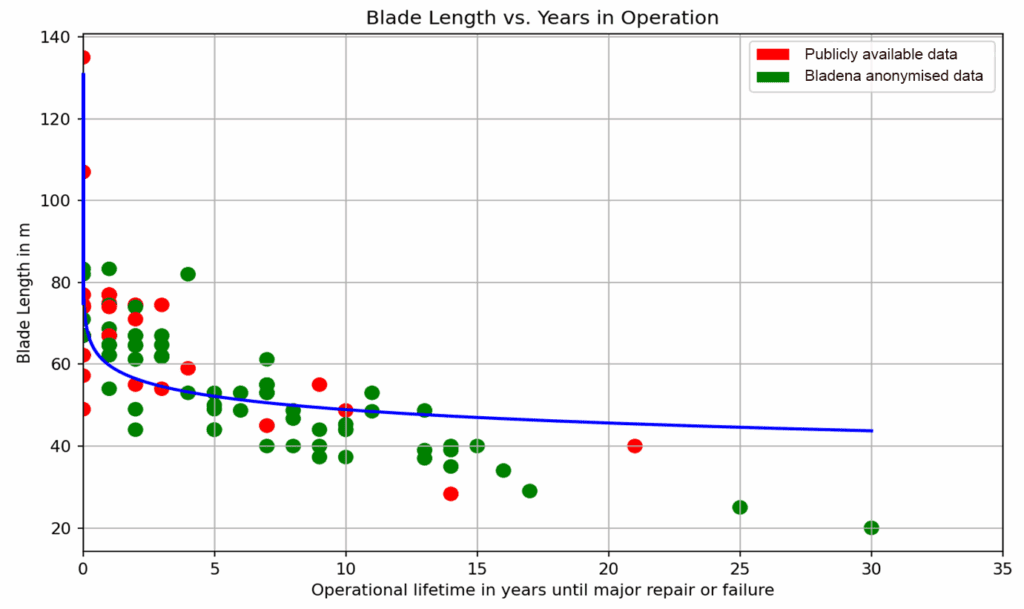
Recent analysis completed by Bladena shows a potential correlation between the likelihood of blade failure within the first five years of operation and blade length. Leading to the conclusion that a key contributing factor in more frequent blade failure could be down to how blade designs are being scaled for larger turbines. Longer blades – which are common today – incur more stress proportional to shorter blades. As most longer blade designs are simply scaled up versions of shorter blades, this additional stress has not been properly factored into the design.
Standards and testing do not fully reflect real-life conditions
Design flaws like these should, in theory, be caught during testing. But there’s a disconnect between what blades are tested for and the conditions that they face in real-life operations, and the gap is widening as larger turbines come to the market.
Designers work to meet the test criteria required for certification, but for longer blades, the criteria is not being revised often enough to reflect the higher stress and fatigue that those blades will experience in operation. As a result, we continue to see issues, which implies that blade design continues to outpace certification criteria. One example we noted from our own analysis is the limited requirements for assessing torsional load.
The current design basis only considers the loads associated with displacements in the edgewise and flapwise direction independently and not the combined three-dimensional effect which is found under actual turbine operating conditions. As a result, a blade can pass certification but still fail within months in the field.
In the race to launch more powerful turbines to accelerate the energy transition, engineers are often designing the next model before field data from the previous version is available to inform design improvements. Without resetting the design methodology, old assumptions persist, even though the data shows new blades behave differently.
Pioneering new testing for real-world conditions
To better understand how blades respond under real operational stresses, Bladena, in collaboration with the Offshore Renewable Energy (ORE) Catapult, is launching full-scale testing of next-generation blade reinforcement technology. Using an 88-metre blade at ORE Catapult’s National Renewable Energy Centre, this programme will carry out torsional load tests for the first time at this scale. The results will help refine blade designs, improve operational longevity, and guide future industry standards, bringing testing closer to the real-world conditions blades experience at sea.
Solving the issue with detailed root cause analysis data
As innovation accelerates to meet net zero ambitions, it is paramount that we align design and testing to real-life scenarios and close the feedback loop for good. Conveniently, the data already exists to do this. By analysing failure data across 130+ blade models, from early designs to today’s multi-megawatt platforms, we’re uncovering the patterns and risks that allow for better decisions across the full blade lifecycle.
The potential impact is vast – billions of dollars in remanufacturing, AEP losses and reputational damage could be abated through a more rigorous approach to applying data insights.
What’s failing most?
Based on our analysis, the five most critical failure modes we see include:
Trailing edge cracking and bondline failure
Transverse cracks in the max chord area
Shear web bondline failure
Cracks & irregularities in transition zones
LPS (Lightning Protection System) related damages
We’ll explore each of these in more detail in a dedicated blog series, sharing what to look for and how to respond before it leads to failure.
If you’re already facing persistent blade issues, now is the time to act.
A robust root cause analysis, grounded in real-world failure data, can uncover hidden drivers and support targeted interventions that reduce risk before it escalates.
We have the data to fix this, so together, let’s make blade failure a thing of the past.
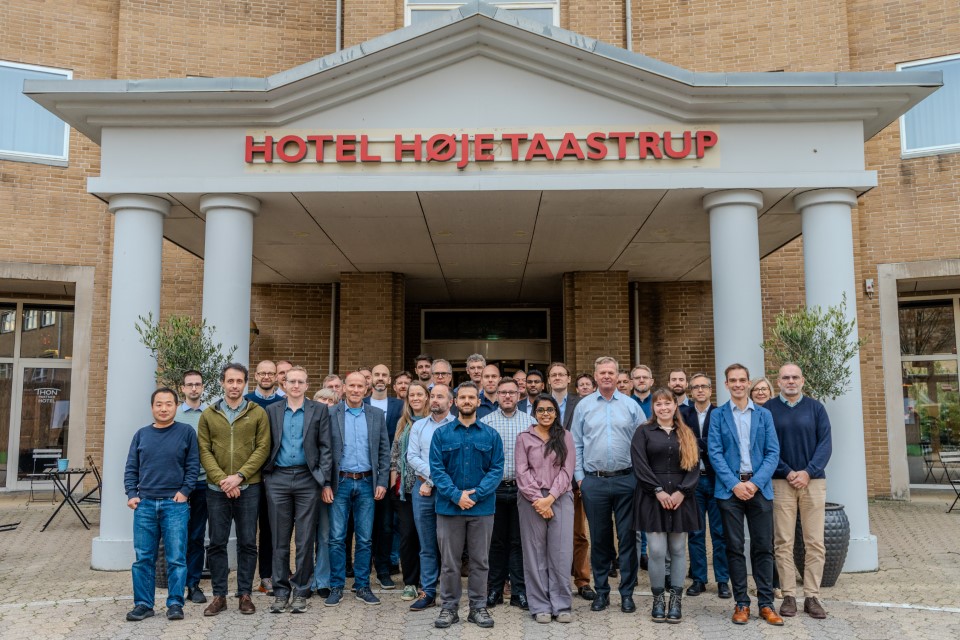
Last week we hosted the CORTIR III International Blade Conference in Copenhagen. The event brought together leading experts from across the wind energy industry to share insights, discuss innovations, and strengthen collaboration on the future of wind turbine blades.
The conference is part of the CORTIR III project, which is funded by Denmark’s EUDP program. The project’s main goal is to improve blade reliability, extend operational lifetimes, and reduce operational expenditure, helping the industry optimise annual energy production and lower the Levelized Cost of Energy. By focusing on risk-based maintenance strategies and advanced monitoring techniques, CORTIR III aims to set new standards for wind turbine blade performance.
Key takeaways from the conference included:
Field measurement campaigns on 7MW turbines provided new calibration data to improve blade modelling accuracy
Blade Optical Deformation Monitoring revealed structural behaviours that can inform inspection and maintenance strategies
Large-scale testing of torsional fatigue loads highlighted solutions for critical phenomena without compromising structural integrity
FEM simulations of the Lattice Bar reinforcement solution showed how CSSD and out-of-plane panel deformation can be prevented, supporting future blade reliability and integration with condition monitoring systems
Panels on standardisation, risk-based maintenance and state-of-the-art inspection techniques offered practical guidance for extending blade lifetime and optimising operational performance
We would like to thank all our panellists who contributed their expertise, including representatives from Nordex Group, Blaest A/S, ORE Catapult, ENGIE, Shanghai Electric Wind Power Group, DNV, Sulzer Schmid, Aalborg University, ScottishPower, Enel Green Power, and RES.
The insights shared at CORTIR III will guide the next phase of the project and support the industry in delivering more reliable blades and more efficient wind farms.
Now part of the RES family, we continue to combine our deep blade expertise with RES’ global network to deliver complete blade care solutions that optimise performance, increase energy production and extend asset lifespans.
The Offshore Renewable Energy (ORE) Catapult has signed an agreement with wind engineering specialist Bladena – a RES company – to test blade reinforcement technology designed to extend the operational life of offshore wind turbines.
With many of the first fleet of operational offshore wind turbines approaching the end of their planned lifespans, there is a need to accelerate the development of new technology which could potentially help extend the life of turbine blades.
The full-scale testing programme at ORE Catapult’s National Renewable Energy Centre in Blyth will use an 88-metre blade to carry out unique full-scale torsional load tests – the first of its kind conducted by ORE Catapult and understood to be an industry first. It will be used to show how Bladena’s reinforcement technology performs under the twisting forces it could experience out at sea.
ORE Catapult will be developing a bespoke test methodology for this programme, with the aim of better understanding how the new reinforcement technology developed by Bladena impacts how the blade responds. Findings could potentially guide industry-wide efforts to improve turbine reliability and reduce lifecycle costs.
Matthew Hadden, Chief Blade Engineer at ORE Catapult, said: “We’re excited to be carrying out this testing with colleagues from Bladena, to examine how we can aid learning of how to better monitor turbine blades as they age through their operational life, with the hope of being able to inform the development of technological solutions across the sector.”
Bladena, part of RES, the world’s largest independent renewable company, is a specialist in wind turbine-blade engineering and lifecycle solutions.
Find Mølholt Jensen, CTO and Founder of Bladena, said: “Testing our technology at ORE Catapult’s world-class facility is a significant milestone in extending turbine lifespans. Stronger blades mean lower costs and more power, and by improving how they withstand stress over time, we can ensure more reliable performance in offshore environments.”
This project builds on years of research by Bladena and partners, including the Technical University of Denmark (DTU) and the Danish Energy Technology Development and Demonstration Programme (EUDP). Their work revealed how even minor torsional loads can accelerate fatigue in composite materials and adhesive joints.
Testing begins January 2026, with preparations already underway.
Further details on Bladena’s technology will be shared early next year.
ENDS
Notes to Editor
About the Offshore Renewable Energy (ORE) Catapult
ORE Catapult is the UK’s leading innovation centre for offshore renewable energy, established in 2013 by the UK Government as part of a network of Catapults set up by Innovate UK in high growth industries.
Independent and trusted, with a unique combination of world-leading test and demonstration facilities, engineering and research expertise, ORE Catapult convenes the sector, delivering applied research, accelerating technology development, reducing risk and cost and enhancing UK-wide economic growth.
ORE Catapult operates in Glasgow, Blyth, Levenmouth, Aberdeen, the Humber, the East of England, the South West and Wales.
About Bladena Bladena, part of RES – the world’s largest independent renewable company, is a specialist in wind turbine-blade engineering and lifecycle solutions. Founded in Denmark in 2011, Bladena serves blade owners, asset managers and operators globally with advisory services, root-cause investigations and proprietary structural technologies (including D-String®, D-TE™, X-Stiffener™ and RTZ Solution™) to address and prevent issues such as cracking, delamination and shear-web failures.
Bladena’s mission is to act as the blade-knowledge centre for the wind industry, combining structural intelligence, field data and engineering innovation to extend blade life, reduce O&M risk and maximise asset value.
London, 29 November 2024 – RES, the world’s largest independent renewables company, has acquired Danish wind turbine blade engineering specialist, Bladena, further strengthening its suite of advanced digital solutions.
Established in Denmark in 2011, Bladena provides engineering expertise to minimise the risk of blade failures for wind farm owners through the entire lifetime of a wind turbine blade. These include proprietary technologies including D-String®, D-TE™, X-Stiffener™, and The RTZ Solution™ that can identify, assess and address blade issues and extend asset lifetimes.
Turbine blades account for approximately 27% of unplanned wind energy O&M costs, and with modern blades exceeding 60 metres in length and their numbers expected to triple over the next decade, addressing early lifecycle challenges is critical to extend turbine asset lifecycles and improve operational reliability.
The acquisition follows closely behind RES’ recent integration with Swiss drone inspection company, Sulzer Schmid, and further strengthens its digital solutions and services businesses.
Eduardo Medina, CEO RES, said: “As we continue to grow, we remain committed to bringing in technologies that provide value to our customers around the world. Acquiring Bladena is a significant step forward for RES as we scale and equip our business to meet growing market demand for digital services and blade maintenance. I look forward to welcoming our new colleagues as we continue our mission to deliver affordable zero carbon energy to communities around the world.”
Arun Narayanan, Digital Solutions CEO, RES added: “Through Bladena we will add industry leading blade technology and engineering expertise to our existing range of solutions such as AnemoLive, AeroUp and TuneUp, which have been shown to drive increased annual energy production. Our customers will now be able to better manage blades and improve turbine reliability, helping reduce costs, enhance revenue, and maximise the value of their investments.”
RES currently supports 41GW of operational assets globally, and over its 40+ year history has developed and/or constructed over 26GW of renewable assets – enough to power 25 million homes for a year. Through the recent acquisitions of Ingeteam and Sulzer Schmid, RES has an enhanced digital solutions and services offering that will serve current and future customers. The company has a development pipeline of 22GW across a range of renewable technologies, due to come to market within the next five years.
ENDS
About RES
RES is the world’s largest independent renewable energy company, working across 24 countries and active in wind, solar, energy storage, green hydrogen, transmission, and distribution. An industry innovator for over 40 years, RES has delivered more than 26 GW of renewable energy projects across the globe and plans to bring more than 22 GW of new capacity online in the next five years.
As a service provider, RES has the skills and experience in asset management, operations and maintenance (O&M), and spare parts – supporting 41GW of renewable assets across 1,300 sites. RES brings to the market a range of purposeful, practical technology-based products and digital solutions designed to maximize investment and deployment of renewable energy.
RES is the power behind a clean energy future where everyone has access to affordable zero carbon energy bringing together global experience, passion, and the innovation of its 4,500 people to transform the way energy is generated, stored and supplied. Visit: www.res-group.com
As part of the CORTIR III project supported by the EUDP (Energy Technology Development and Demonstration Program), we have performed a field measurement campaign on the 7MW ORE Catapult Levenmouth Demonstration Turbine in Scotland, featuring 83.5-meter blades.